Screen-Free Activities for Toddlers That Actually Hold Attention
Most toddler toys get abandoned in a day. The ones that don't have one thing in common: there's no single right way to use them.
That's the whole game with screen-free activities for toddlers. Your two-year-old isn't going to sit still for an hour, and in 2026 the pressure to hand over a tablet is everywhere. But you don't need a screen to buy yourself 30 quiet minutes. You need the right activity, set up the right way, matched to how a toddler's attention actually works.
This post gives you screen-free activities sorted by how long they really hold a toddler, why fewer toys beat a pile of them, what the pediatric guidelines actually say about screens, and the easiest low-effort setup for a hard day.
What Are the Best Screen-Free Activities for a Toddler?
The best screen-free activities for a toddler are open-ended and hands-on: coloring on a big surface, pretend play, building and stacking, water and sensory play, and simple movement games. Kids this age stay engaged longest when there's no "right" answer, so an open-ended activity holds attention far longer than a one-and-done toy.
Here's why that matters. A puzzle has one solution, so it's over in five minutes. A giant coloring banner or an open notepad has no finish line, so your toddler keeps going, comes back, and adds more the next day.
Open-ended beats closed-ended almost every time at this age. Keep that one rule and half your toy problem solves itself.
How Long Should a Toddler Actually Focus on One Thing?
Expect about two to three minutes of focus per year of age. A two-year-old might lock in for four to six minutes, a three-year-old for six to eight, according to age-by-age attention span guides. Anything past that is a bonus, not the baseline.
This changes everything about how you pick activities. If you expect an hour of independent play, every activity "fails." If you expect six minutes and stack two or three good options, you've got a calm afternoon.
Interest, hunger, and distractions all move that number. A toddler who's fed, rested, and into the activity will blow past the average. One who's tired won't touch anything. Read the kid, not the clock.
Why Fewer Toys Hold a Toddler's Attention Longer
Fewer toys lead to longer, deeper play. When University of Toledo researchers gave toddlers four toys instead of 16, the kids played twice as long and in more creative ways with the smaller set.
The pile is the problem. With 16 toys in reach, a toddler touches one, drops it, grabs the next, and never settles. With four, they actually explore what each one can do.
The study, published in Infant Behavior and Development, backs up what a lot of tired parents already feel: a cluttered playroom makes for scattered play. So before you buy another toy, try clearing the field. Put most of the bin away and leave out two or three open-ended things.
That's not deprivation. That's focus.
Screen-Free Activities That Hold a Toddler the Longest
Some activities buy you five minutes. Some buy you forty. Here's a rough guide by age, attention hold, and how much mess you're signing up for.
| Activity | Best age | Roughly holds them | Mess level |
|---|---|---|---|
| Giant coloring banner (floor or wall) | 2 to 8 | 30 to 45 min, plus repeat days | Low (washable markers) |
| Playtime notepad (pretend-play prompt) | 2 to 6 | ~10 min per sheet, often an hour+ | Very low |
| Water transfer play (cups, spoons, bin) | 2 to 4 | 15 to 25 min | Medium (towel nearby) |
| Pretend play (kitchen, dolls, cars) | 2 to 5 | 10 to 20 min | Low |
| Stacking and building blocks | 18 mo to 4 | 8 to 15 min | Low |
| Indoor obstacle course (cushions, tape) | 2 to 5 | 10 to 20 min | Low |
Notice the top of the list. Coloring on a big surface wins because it's open-ended and physical at the same time. A giant coloring banner rolls out on the floor, so your toddler colors a dinosaur one minute and lies across it the next. There's no wrong way to do it, which is exactly why it holds.
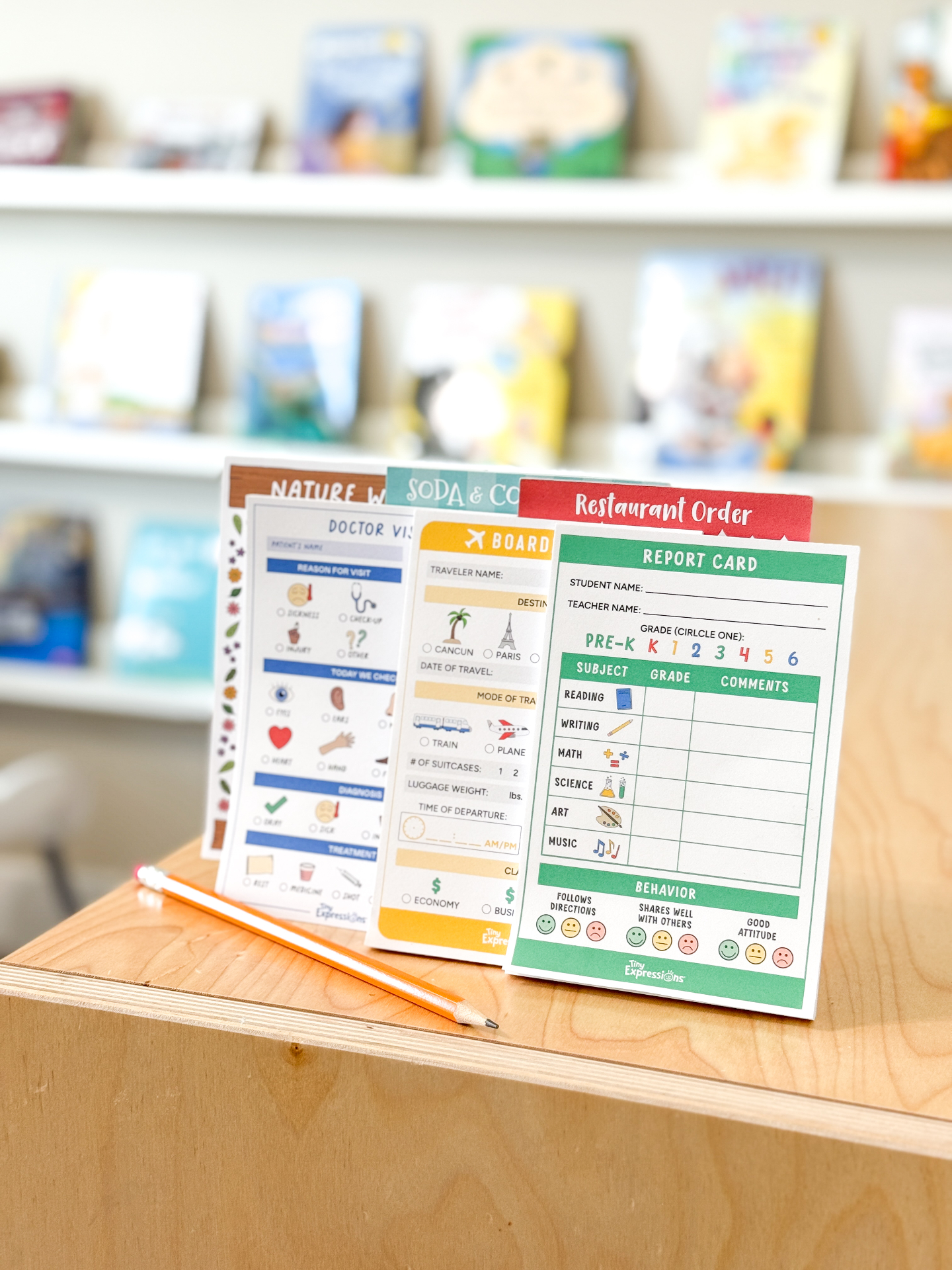
For quieter moments, a notepad does the same job smaller. Our playtime notepads are the store's number-one bestseller for a reason: they fit in a bag, need zero setup, and hand your kid a ready-made scenario instead of a blank page. We see about 10 minutes of play per sheet, and a single sheet often kicks off something much longer.
What Do the Screen Time Guidelines Actually Say?
For kids ages 2 to 5, the American Academy of Pediatrics suggests capping screens at about one hour a day of high-quality content, ideally watched together. For under 18 months, the AAP recommends skipping screens except for video chatting with family.
But the newer guidance is less about the stopwatch and more about balance. The AAP's 5 C's of media framework asks parents to think about child, content, calm, crowding out, and communication, not just minutes.
The one line worth remembering: screens shouldn't crowd out sleep, movement, family time, or free play. So this was never about guilt. A show while you make dinner is fine. The goal is just to make sure your toddler has something better to reach for the rest of the day.
That "something better" is what this whole list is for.
The Easiest Screen-Free Setup for a Hard Day
On a rough day, pick one open-ended activity, set it up before your kids ask, and keep it low-effort for you. The best ones do part of the imagining for you, so you're not inventing a storyline from scratch when you're already worn out.
That last part matters more than most parenting advice admits.
Every summer morning around here starts the same way. "What are we going to do today?" Some days there's camp. Some days there's a grandparent. On the days there's neither, it's on me.
And I'll say it out loud: imaginative play does not come easy to me. Sitting down and inventing a story, then keeping it alive so everybody's still having fun, is harder than it sounds. Time creeps. The storyline dies. You've been there.
That's a big part of why our playtime notepads exist. They hand you the scenario so you don't have to invent one.
Here's what that looked like in our driveway this summer. My 4-year-old and 6-year-old wanted to ride bikes, so I grabbed the cookie and soda notepad and turned it into a drive-through. A cardboard box became the shop. One kid ran the counter and wrote down orders. The other pedaled up, ordered, and waited for it to get filled. Then they swapped.
They played that for over an hour on the notepad alone, and it spun off into other games for the rest of the afternoon.
I figured they'd tear through the whole pad in ten minutes. They used five to seven sheets. That lines up with what we see across our notepads generally: roughly 10 minutes of play per sheet, give or take depending on the kid and the game.
The notepad wasn't the toy. It was the starting line.
So if pretend play doesn't come naturally to you, you're not doing it wrong. You just need a prompt instead of a blank page. Our playtime notepads are built for exactly that, and the rest of our best sellers are the screen-free activities that hold kids the longest. If you want the story behind why we make them, that's on our story page.
The Bottom Line
Screen-free activities for toddlers work best when you stop fighting your kid's attention span and start working with it. Three things to remember: expect short focus (two to three minutes per year of age), keep fewer toys in reach so play goes deeper, and lead with open-ended activities that have no finish line.
Start with one. Roll out a giant coloring banner or hand over a playtime notepad, and see how long your toddler actually stays. You'll probably be surprised.
Because the best screen-free activity isn't the fanciest one. It's the one that's already out, ready, and open-ended when the "I'm bored" hits.
Frequently Asked Questions
What are good screen-free activities for a 2-year-old?
Good screen-free activities for a 2-year-old are simple and open-ended: coloring on a big surface, water transfer play with cups and spoons, stacking blocks, and basic pretend play. Keep sessions short, around five to ten minutes, and rotate a few options rather than putting everything out at once.
How long can a toddler play independently?
Most toddlers play independently for about two to three minutes per year of age, so roughly four to eight minutes for a 2 to 3-year-old. A highly engaging, open-ended activity can stretch that much longer, especially if the child is fed, rested, and genuinely interested.
Are screens actually bad for toddlers?
Screens aren't bad, but the American Academy of Pediatrics suggests limiting kids ages 2 to 5 to about one hour a day of high-quality content, and avoiding screens under 18 months except for video chats. The bigger point is that screens shouldn't crowd out sleep, movement, and hands-on play.
Why won't my toddler play with their toys?
Often it's too many toys at once. Research from the University of Toledo found toddlers played twice as long and more creatively with four toys than with 16. Try putting most toys away and leaving out two or three open-ended options.
What is the best screen-free activity for a rainy day?
A giant coloring banner is one of the best rainy-day picks because it's open-ended, low-mess with washable markers, and holds a toddler for 30 to 45 minutes, often across multiple days. Pair it with a simple indoor obstacle course to fill a whole morning.
What if I'm not good at pretend play with my kids?
You don't need to invent the story yourself. Use a prompt-based activity that hands you the scenario, like a themed playtime notepad that turns bikes and a cardboard box into a drive-through. Anchoring the play in a specific setup means your kid's imagination does the work, and the game keeps going without you steering every turn.


